

Bottom of License
Many medical tasks can now be accomplished through self-service. We should let AI handle this.

Modern medicine has been obsessed with doctors working at the “top of license” - the idea that physicians should only do work that only physicians should do. In practice, this takes two forms: delegating more authority to other healthcare professionals, and reducing administrative burden. Fundamentally, we have tried to reorganize the clinic so other people do our work. Plenty of that work is complex, but much of it is not - it just requires a licensed professional to do it. But what if patients could do this work for themselves?
This work has a name: the bottom of license. These are the many things that technically require a professional license - but just barely. The bottom of license includes things like ordering screening labs and imaging, prescribing preventive treatments, straightforward medication titrations and refills, and basic diagnosis and management. In other words, the easy stuff. Medical AI presents a new opportunity to move these offerings into a self-service model. Rather than insisting that huge swaths of low-risk activities continue to require involvement of a human professional, we can just automate it - and we should.
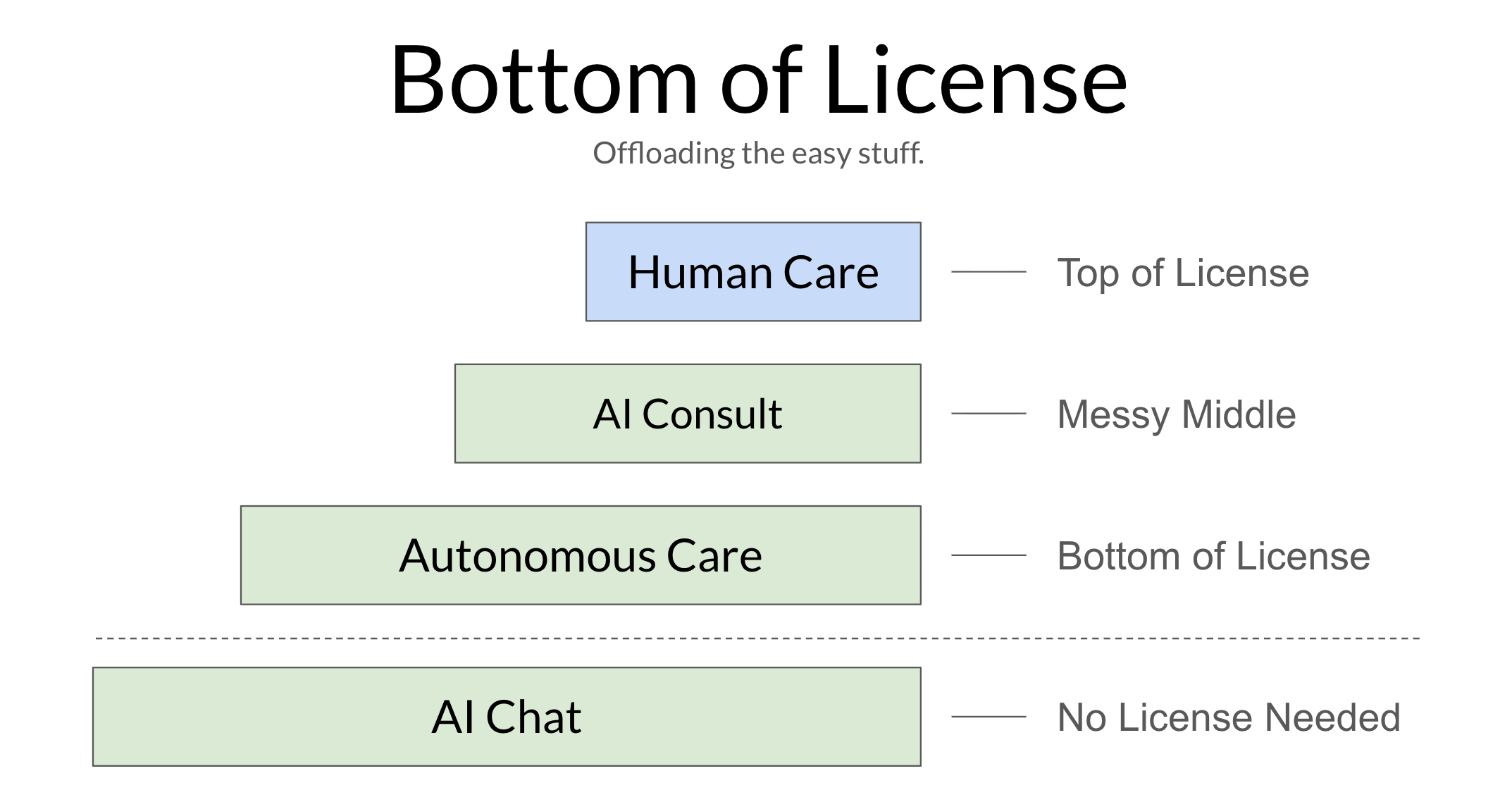
Medicine has already tried everything short of giving up this layer of decision making. Clinics place “standing orders” allowing non-doctors to make decisions. Physicians delegate this work routinely to APPs and pharmacists who themselves follow protocols or, in some places, can simply practice independently. And direct-to-consumer testing and treatment offerings are often effectively a form of self-service - utilizing pre-built pathways to determine appropriateness. And yet, the formalities persist.
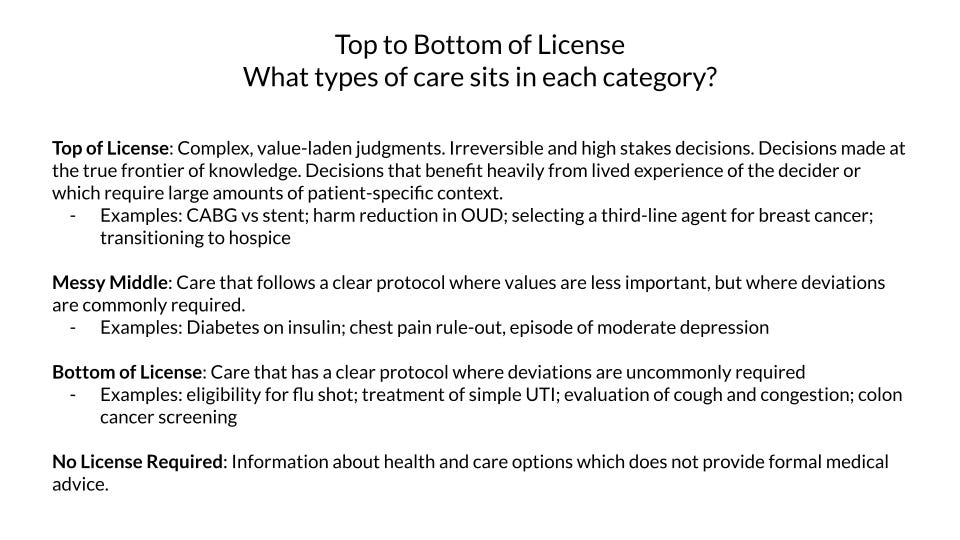
The most common arguments against this approach are safety-related - but that assumes that this cannot be done safely. Many of the activities encompassing the bottom of license have already been effectively “automated” in practice, and medical AI simply extends this into a pure self-service model.
Moreover, self-service does not need to achieve “zero risk” to be acceptable. Society allows individuals to self-service many activities with low but non-zero risk. Is self-prescribing a statin any riskier than taking out a loan to buy a car? Both can theoretically cause serious harm - albeit at low rates. We address these concerns with disclosures, guardrails and backstops - the loan terms are clear, a credit check ensures someone doesn’t get overwhelmed with debt, and the requirement for monthly payments provides ongoing monitoring of financial health. There are analogous mechanisms throughout medicine, and a new one as well - the AI itself. The point is that a human need not be involved to proceed. Self-service medicine does not mean “on your own.” It means designing systems that help people do the things they already know they need to do safely and effectively with less impediment.
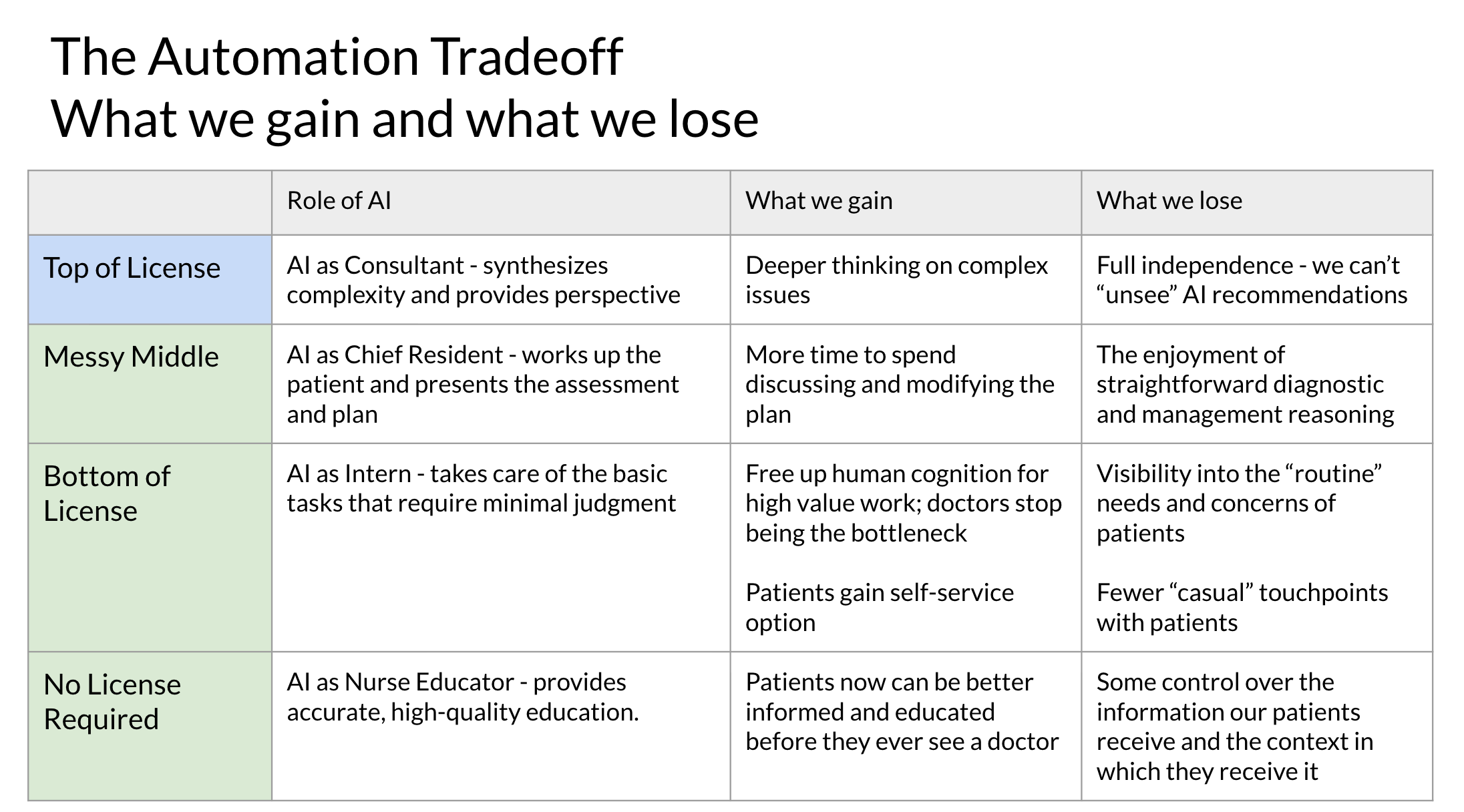
Moving to a self-service model for bottom of license work is a natural early deployment for medical AI. It provides real value to patients and providers by removing friction that impairs health behaviors and clogs up clinics. Simultaneously, it creates a role for medical AI that allows developers, clinicians and patients to gain experience with the technology that informs higher-stakes use cases.
A license is a powerful tool, and things that require that license should matter. We can use medical AI to say farewell to the bottom of license and raise the floor of what requires physician capabilities in the era of cognitive systems.
Hey — I came across your writing and really liked how you think.
I’m exploring something similar from a different angle — writing about human behavior through a system design lens (like debugging internal patterns).
Just started publishing on Substack. If you ever get a moment to read, I’d genuinely value your perspective.
Also happy to support your work — feels like there’s an interesting overlap here.
Agreed! And a massive opportunity exists in the pharmacy profession to allow AI to perform "bottom of the license" tasks. AI will create significant productivity gains in pharmacy teams. The question will be, how will we utilize the new available time created.